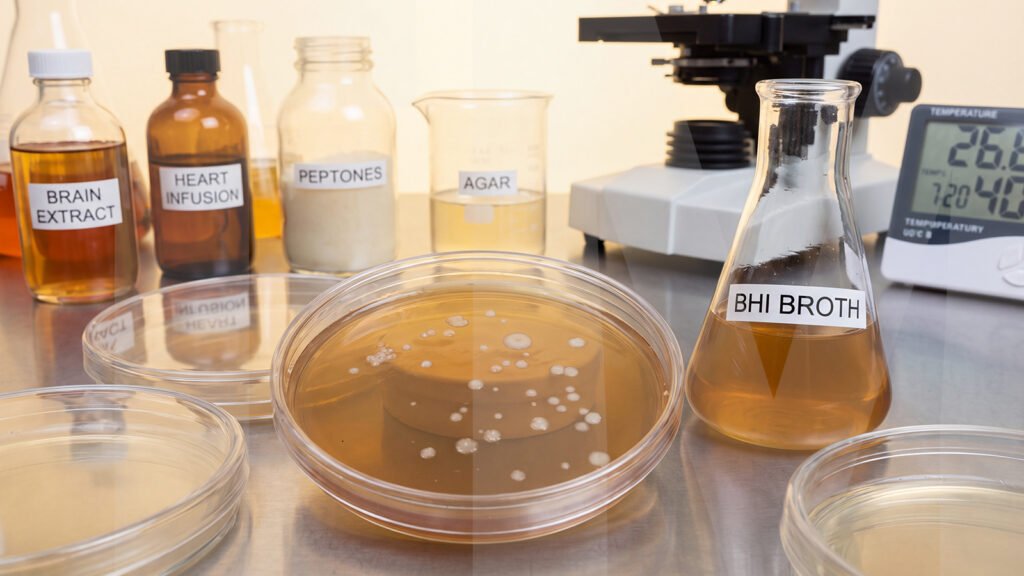
A colony appearing on an agar plate may look like a simple result. Yet, that small colony reflects everything the microorganism needed to grow.
The microbial development is dependent on the nutrients present, on the environmental conditions and the culture medium. The choice of medium becomes even more important if the organism has demanding nutritional requirements.
A richer formulation can provide the nutrients to encourage such growth. This type of nutritional support is provided by Brain Heart Infusion Agar with its carefully selected components.
But what makes this medium so nutritionally supportive?

Brain Heart Infusion Agar is a highly nutritious solid culture medium. It supports the growth of a wide range of bacteria, yeasts and moulds. The medium is saturated with brain and heart tissue.
These infusions are rich in complex nutrients for the growth of microorganisms. Peptones also provide additional nitrogenous nutrients and amino acids.
The agar creates a solid surface for microbial growth. It is a good format for microbiologists to make observations and study grown colonies.
BHI Agar can support organisms with greater nutritional requirements than most routine culture media. The formula also permits the addition of supplements for particular microbiological requirements.
Each component contributes a specific function to the medium. The formulation combines several nutritional and supportive ingredients.
Brain infusion gives complex nutrients and growth-supporting substances. Heart infusion provides additional nutrients for the growth of microbes.
Peptones provide amino acids and other nitrogenous materials. These nutrients are used by microorganisms for cell growth and metabolism.
Dextrose is a readily available source of carbohydrate. Microbial cells can metabolize this carbohydrate for energy.
The medium is supplemented with sodium chloride to maintain the osmotic condition. This balance allows the microbial growth under suitable conditions.
Disodium phosphate is used as a buffer in the formulation. It maintains the proper pH during the growth of the microbes.
Agar is the solidifying agent. It transforms the nutrient composition into a solid surface that can support colony development.
These components together provide a medium to give broad nutritional support.
Brain Heart Infusion Agar supports a wide variety of microorganisms. In particular, it benefits organisms that need nutritionally rich conditions to grow.
Fastidious bacteria can grow on the medium when appropriate incubation conditions are provided. Several non-fastidious bacteria can also develop on BHI Agar.
The medium also supports many yeasts and moulds. This makes it useful across both bacterial and fungal cultivation workflows.
However, microbial growth is dependent on several factors. These include the organism, inoculum, incubation temperature, incubation period, and sample characteristics.
Different organisms can also have different colony appearances. These differences are visible to microbiologists when testing cultures.
The medium itself does not identify an organism. Users need suitable identification methods after obtaining microbial growth.
Brain Heart Infusion Agar and Brain Heart Infusion Broth share a similar nutritional foundation. Their main difference comes from their physical form.
BHI Agar Contains agar to provide a solid surface for growth. After incubation, microbiologists can then see individual colonies.
BHI Broth remains liquid because it does not contain a solidifying agent. This format allows microorganisms to grow throughout the liquid medium.
The term ‘Brain Infusion Broth’ can refer to liquid formulations based on similar nutritional principles. Microbiologists commonly use BHI broth when they require a liquid culture environment.
The choice depends on the intended workflow. Solid media are used for colony formation and observation, and liquid media are used for growth in broth.
BHI Agar can be used by microbiologists for the cultivation and recovery of nutritionally demanding microorganisms. Its wide spectrum of growth-promoting properties makes it suitable for a large number of microbiological workflows.
The medium may be used for primary isolation if the required organism requires the enriched nutritional conditions. It can also support the maintenance of suitable microbial cultures.
Clinical microbiology can use BHI-based media for recovering fastidious organisms. Researchers can also use the medium during bacterial and fungal culture studies.
Microbiologists may supplement the base medium for specific requirements. Blood enrichment can provide additional growth factors for selected organisms.
Some formulations can also include antimicrobial agents for particular applications. Users should select the formulation according to the target organism and testing requirement.
The solid surface provides another practical advantage. Microbiologists can examine colony morphology after suitable incubation.
Proper medium selection is still important for successful microbial recovery. The user should always follow the recommended conditions for preparation and incubation.
The selection of a culture medium is more than just a place to grow microorganisms. This requires knowledge of the organism, the purpose of cultivation and the conditions required for reliable recovery.
Microbiologists can use this knowledge to select a medium that best fits their intended workflow. It also minimizes unnecessary trial and error in microbial cultivation.
For demanding organisms, making an informed medium choice can be an important step toward obtaining consistent and interpretable culture results.
A. Yes. If additional nutrients for growth are needed, BHI agar can be used as a base for blood-enriched formulations.
A. Some BHI-based media can support the growth of some anaerobes if the user provides the appropriate anaerobic conditions. The medium alone does not create anaerobiosis.
A. Yes. Dextrose is a carbohydrate source in the formulation.
A. Unwanted microorganisms may grow in the medium and can make cultural interpretation difficult. Contaminated plates therefore cannot be used for reliable microbiological testing.
A. A nutrient-rich formulation can promote good growth of the relevant microorganism but the growth rate is still dependent on the organism and the conditions of incubation.
A microbiologist receives a mixed sample and prepares a fresh culture plate. The next question seems simple: which organism will...
Read More
A microbiologist opens two Petri plates after incubation. Both plates contain the same sample. One plate shows clear, well-separated colonies....
Read More
When a microorganism moves from the laboratory to commercial biofertilizer production, one question becomes particularly important: what will you use...
Read More
Every morning the microbiology lab receives fresh agar plates from the incubator. Each plate carries dozens of tiny bacterial colonies....
Read More
A water quality laboratory receives samples taken from different points of a distribution network. The testing team shall determine whether...
Read More
How can I help you today?
