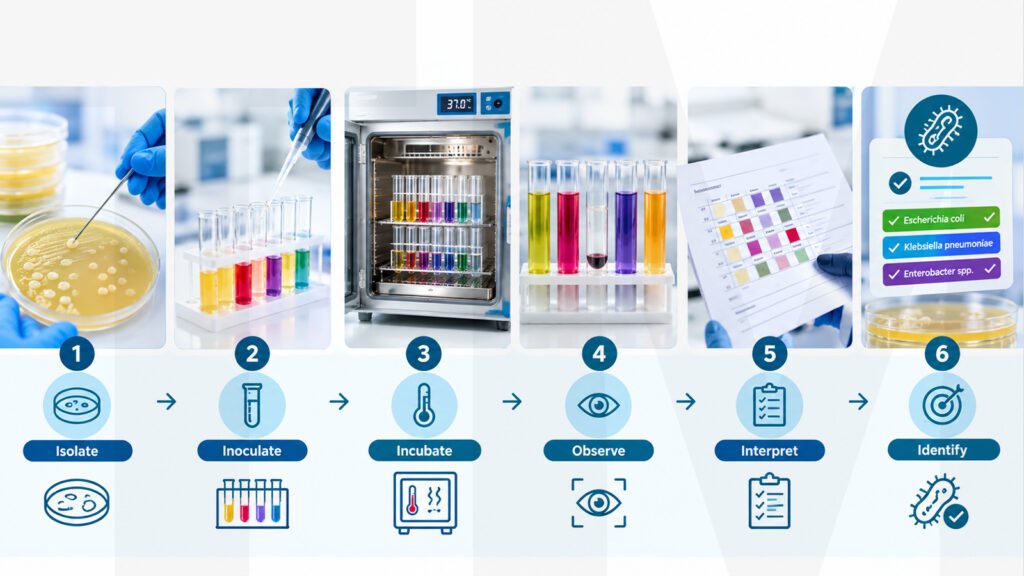
Two bacterial colonies can appear nearly indistinguishable on an agar plate. Yet their metabolic activities can expose significant differences. A laboratory professional cannot always be able to tell what bacteria is growing by looking at the colonies or microscopic examination alone. They need more data to distinguish between similar types of organisms.
These differences can be determined with a Biochemical Test that examines specific metabolic reactions. These reactions provide a crucial clue about an organism’s identity. By combining these observations with established identification criteria, the laboratory is able to build a more reliable picture of an unknown bacterial isolate.
Biochemical Test are laboratory tests that assess the metabolic and enzymatic activities of microorganisms. They test the ability of organisms to carry out specific biochemical reactions and thus are useful for the identification of microorganisms that are similar in characteristics.
In microbiology, these methods are employed to analyze the properties such as carbohydrate fermentation, enzyme production, and substrate utilization. Each test is standardized to detect a particular biological activity under controlled conditions.
For example, some bacteria have the enzyme catalase which catalyzes the breakdown of hydrogen peroxide into water and oxygen. Others have no detectable catalase activity at the same test conditions. These results are useful for excluding possible bacterial identities.
Hence, biochemical test offer useful clues for microbial identification if the laboratories evaluate their result in the context of other relevant findings.
Microorganisms have different enzymes and ways of carrying out chemical processes. The differences in this area are reflected in their abilities to metabolize some carbohydrates. These reactions and other enzyme activities can be seen using this test.
Some biochemical test check for enzyme activity directly while others look at the ability of the microorganisms to break down chemical substances. The results help to find out what kind of characteristics an organism has compared to similar microbes.
For example, the citrate test is used to reveal whether bacteria can use citrate as the sole carbon source within a particular environment. The urease test checks for the activity of urease which shows if bacteria can use urea.
Each test examines a certain biological feature. Laboratories choose appropriate methods based on the organisms to be investigated and the identification question.
These are some examples of each test providing different information. The choice is based on the organism, the type of assay and the identification methods that are available.
The accurate interpretation of results will depend on the preparation and on the constancy of test conditions. The laboratory professionals should follow the recommended procedure for each medium and reagent.
First the laboratory professionals choose a test for the bacterial isolate. Then they prepare the medium and the reagent according to the protocol. After inoculation with the culture laboratory professionals maintain the incubation conditions.
After incubation laboratory professionals check the reaction according to the established criteria for the test. Some reactions involve a colour change while other reactions show gas formation or other observable changes.
The visual observation itself does not confirm the result. Laboratory professionals should observe the recommended reading time. Use appropriate positive and negative controls when indicated. These controls allow the identification of problems with the procedure, reagents or interpretation.
Lab professionals can determine the result based on a combination of biochemical test results because one test is usually not enough to identify an unknown bacterium. Different bacteria can show the same result for one biochemical reaction, so it is necessary to observe several reactions altogether.
They can identify an unknown bacterium using biochemical test results by comparing them with known bacterial identification profiles. They can also use colony morphology and microscopic appearance of cells, as well as growth conditions and other factors. This overall analysis can help figure out what the bacteria might be. It can also help understand results that don’t match.
In microbiology the this test plays an important role in this process. Its value is in how you interpret each individual reaction within the broader profile instead of thinking each result is the final answer.
Several factors may influence the results of biochemical tests. Unwanted microorganisms in the culture may cause reactions, which may hinder the interpretation of the findings. Test results of this test may also be affected by factors like improper storage or expired reagents.
The conditions during incubation require equal attention. Incorrect temperature, unsuitable incubation duration, or delayed reading can affect which tests work properly under certain procedures. These deviations can lead to wrong conclusions.
In the lab these kinds of risks can be avoided by using procedures that have been tested and proven to work by keeping reagents properly stored and monitoring how the tests are being carried out. If a result is inconsistent with results, professionals should investigate any unusual reactions, not try to fit the result to an expected identification.
Biochemical testing is still used for routine identification of microbes in applications such as food testing and research. They also allow laboratories to explore metabolic characteristics with appropriate procedures and suitable lab resources.
Automated identification systems measure a wide variety of biochemical reactions, and the resulting profiles can be compared with reference databases. In cases where biochemical evidence is inconclusive and requires confirmation, molecular techniques may also help to give more evidence.
This test can do more than just identify microbes. It also helps researchers to understand how they work and compare the ways of different organisms in using nutrients. The usefulness of these tests rely on the choice of tests and how they are interpreted within each method.
A biochemical test is a laboratory reaction that correlates with the biology of a microorganism. Every single result is a link in the chain of evidence required to separate bacterial isolates and understand their characteristics. Using correct technique, controls and combining analyses gives labs more accurate identification conclusions.
A. No. Additional biochemical, molecular, or other identification methods may be necessary for some species of bacteria to accurately identify them.
A. Biochemical testing is used to identify the metabolic or enzymatic activity of organisms. Molecular testing is used to determine if a particular organism contains specific genetic information.
A. This system has several biochemical reactions combined into small compartments or wells, which produce a profile that can be used to identify microorganisms.
A. Yes. Different biochemical reactions can occur in different strains of the same species.
A. Conventional testing can be performed with most laboratory equipment; however, there are other forms of testing that will require specialized instrumentation or automation.
A microbiologist studies a bacterial culture that looks no different from many others. Yet, its metabolic capabilities may be an...
Read More
A small tube sits on a microbiologist’s bench, looking almost ordinary. Its orange medium waits for one biological event to...
Read More
A microbiologist often looks beyond what appears on a culture plate. A tiny change in colour can reveal an important...
Read More
A colony appearing on an agar plate may look like a simple result. Yet, that small colony reflects everything the...
Read More
A microbiologist receives a mixed sample and prepares a fresh culture plate. The next question seems simple: which organism will...
Read More
How can I help you today?
