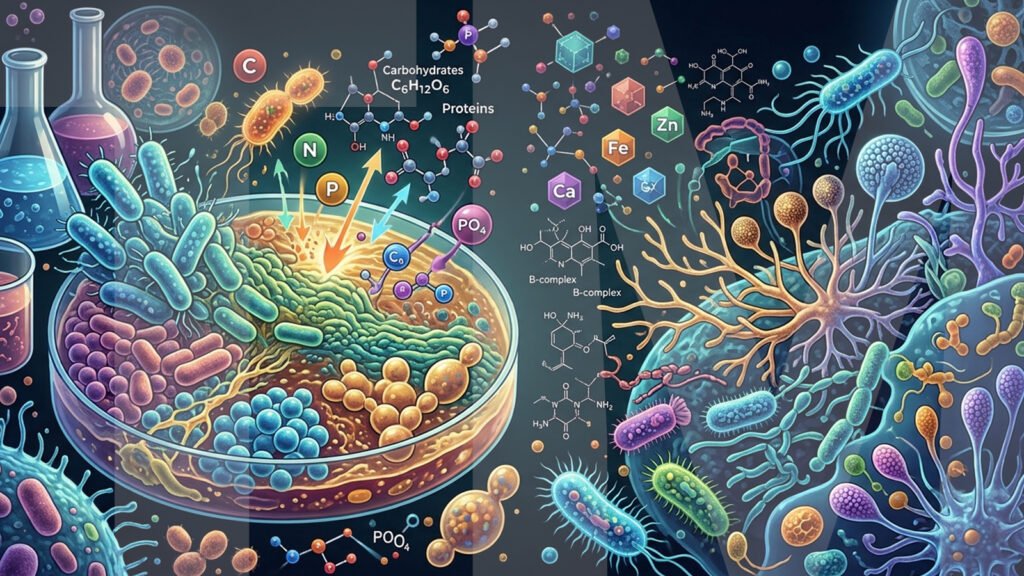
A microorganism can be invisible to the naked eye; however, its growth is dependent on several essential requirements. Bacteria will start using the nutrients available to them to grow, multiply and conduct metabolic processes once placed into a suitable culture medium. These nutrients are limiting factors for the in vitro development of microorganisms.
Like any other living thing, microbes cannot live and reproduce without enough food. Some nutrients are important in trace amounts only, while others are required in large amounts. To understand how they contribute to the growth of microorganisms and why culture media contain different nutritional components, it is important to understand the micro- and macro-nutrients.

Microorganisms have a range of chemical needs which are important for them to keep their cell structure and to carry out metabolic reactions. Scientists categorise these nutrients based on the quantity required by the microorganisms. Macronutrients are required in large amounts, whereas micronutrients are required in smaller amounts.
The main difference between micro- and macro-nutrients is the amount needed. All the nutrients required by an organism, whether they be macronutrients or micronutrients, are essential for many processes within the cell. Some elements in small quantities can have an influence on the metabolism, enzyme activity and growth of the microorganism.
To build up the components of the cell and metabolic reactions, microorganisms will require some vital nutrients. These essential macronutrients include carbon, hydrogen, oxygen, nitrogen, phosphorus and sulphur.
Carbon is an important ingredient for building up the basic framework of the cell such as carbohydrates, proteins, lipids and nucleic acids. Hydrogen and oxygen are used to produce water and organic molecules. They are also involved in energy-producing reactions.
Nitrogen helps in the formation of amino acids, proteins and nucleic acids. Phosphorus helps to create DNA, RNA and ATP. ATP is a molecule that provides energy for metabolic reactions and sulphur is used in the synthesis of some amino acids and cellular compounds.
Microorganisms also need potassium, magnesium and calcium. Potassium is involved in the functioning of cells and the activity of enzymes. Calcium gives structure to the cell, and magnesium is essential to ribosome stability and functioning.
Microorganisms need small amounts of micronutrients in order to conduct important cellular processes. Common trace elements include iron, zinc, manganese, copper, cobalt and molybdenum.
These are often used as cofactors in enzymes. Iron is important in energy production and electron transport. Zinc helps with the structure and function of enzymes and copper helps with electron transfer. Manganese helps with several enzymes in metabolic reactions.
Cobalt is involved in metabolic processes together with vitamin B12. Molybdenum assists some enzymes in carrying out reactions in nitrogen metabolism.
If there is a lack of trace elements it can affect enzymes within the microorganism. However, excessive concentrations can cause toxicity in microorganisms. An appropriate amount is needed in each microorganism so they can function normally in their cells.
Microbes need a suitable nutrient medium to grow under laboratory conditions. They are grown on culture media that contain the necessary nutrients for their growth. The composition is varied depending on the nutritional requirements of target microorganisms.
Typical ingredients of this medium are peptone, beef extract, yeast extract and carbohydrates. Peptone is a source of amino acids, peptides and other amino nitrogen compounds. Beef and yeast extracts supply vitamins, minerals and growth factors. There are some microbes which can use carbohydrates as their source of carbon and energy.
Mineral salts provide minerals such as magnesium, potassium, phosphorus and sulphur. Some media have particular trace elements to encourage certain microbial activity.
Different culture media are selected depending on their intended purpose or the organism being cultivated. For example, Nutrient Agar can be used to culture most nonfastidious organisms. Other specialised media have additional components to supply specific nutritional requirements.
The main difference between micro- and macro-nutrients is that macro-nutrients are required for the build-up of cell structure and perform major metabolic reactions, while micro-nutrients are required for some biochemical reactions . Macro nutrients are carbon, nitrogen, phosphorus and sulphur. These are required in larger amounts by microorganisms.
Micronutrients include iron, zinc, copper and manganese. These are required in lower concentrations within the cell, often to help with enzyme activity and electron transfer.
Macronutrients are needed for microbial growth and cell development. Micronutrients help control vital metabolic reactions. Its availability will affect microbial growth and laboratory cultivation.
Trace elements are also important for laboratory applications . For example, zinc is a co-factor for many microbial enzymes and is involved in critical metabolic reactions. Its availability can affect microbial activity under suitable growth conditions.
Zinc Sulphate Heptahydrate (3508) is used as a source of zinc for various uses and also as a laboratory reagent. It is used by industries in fertilisers, agricultural sprays and animal feeds. It can be found used as a coagulant in rayon manufacture and in zinc plating electrolytes. Such applications also include dyeing fabrics, preserving leather and medicine.
This demonstrates how an indispensable component can act as a catalyst in scientific, agricultural and industrial fields.
Metabolism and growth keep the cells alive. Each nutrient has its own function, whether it is to maintain the cell’s components or to help catalyse the reactions of enzymes.
The knowledge of the different micro- and macro-nutrients will help to understand their role in microbial nutrition. Their balanced availability is also key in developing suitable culture media. Knowledge of micro- and macro-nutrients ultimately helps to create an appropriate environment for microbial cultivation and lab investigations.
Find out more about Zinc Sulphate Heptahydrate (3508) product.
A. Most microorganisms cannot produce all the vitamins they need. The addition of vitamins in culture media is because they are vital compounds and encourage microbial growth.
A. Certain bacteria have special nutritional requirements, providing additional growth factors for good growth.
A. Trace elements are minerals needed in small amounts for enzyme activity and other functions of the cell.
A. Having the right nutritional balance will help microbes to grow.
A. Yes, since excessive amounts of certain nutrients can cause an imbalance in the cells and inhibit their growth. Some compounds can be toxic in larger concentrations.

A patient undergoes treatment for a bacterial infection, expecting the prescribed antibiotic to help. However, the antibiotic prescribed might not...
Read More
Two bacterial colonies can appear nearly indistinguishable on an agar plate. Yet their metabolic activities can expose significant differences. A...
Read More
A microbiologist studies a bacterial culture that looks no different from many others. Yet, its metabolic capabilities may be an...
Read More
A small tube sits on a microbiologist’s bench, looking almost ordinary. Its orange medium waits for one biological event to...
Read More
A microbiologist often looks beyond what appears on a culture plate. A tiny change in colour can reveal an important...
Read More
How can I help you today?
