
Every microbiologist has seen this happen.
A clinical specimen from a patient with suspected bacterial meningitis is received. The sample is processed with care and inoculated onto standard culture media. After incubation, one plate shows little or no growth. So does that mean there is no bacteria in the sample?
Not always.
Some bacteria are far more demanding than others. They need some nutrients before they grow into visible colonies. If the proper medium is not used, these organisms can go undetected despite being present in the specimen.
That is why laboratories do not rely on a single culture medium. The choice of media depends on the organism they want to recover.
This is where chocolate agar becomes important. It is intended to isolate those nutritionally demanding bacteria that do not grow properly on standard media. For many laboratories, it remains an essential part of routine culture work.
Not all bacteria grow under the same conditions.
Some organisms need nutrients that are normally found inside red blood cells. These nutrients are released only when the blood cells are lysed in the preparation of the media. That’s why microbiologists use chocolate agar when they suspect fastidious pathogens. The medium is a nutrient-rich environment that encourages their recovery from clinical specimens. The name of the medium may suggest otherwise, but it does not contain chocolate. It derives its brown colour from heated blood, giving the medium a chocolate-like appearance.
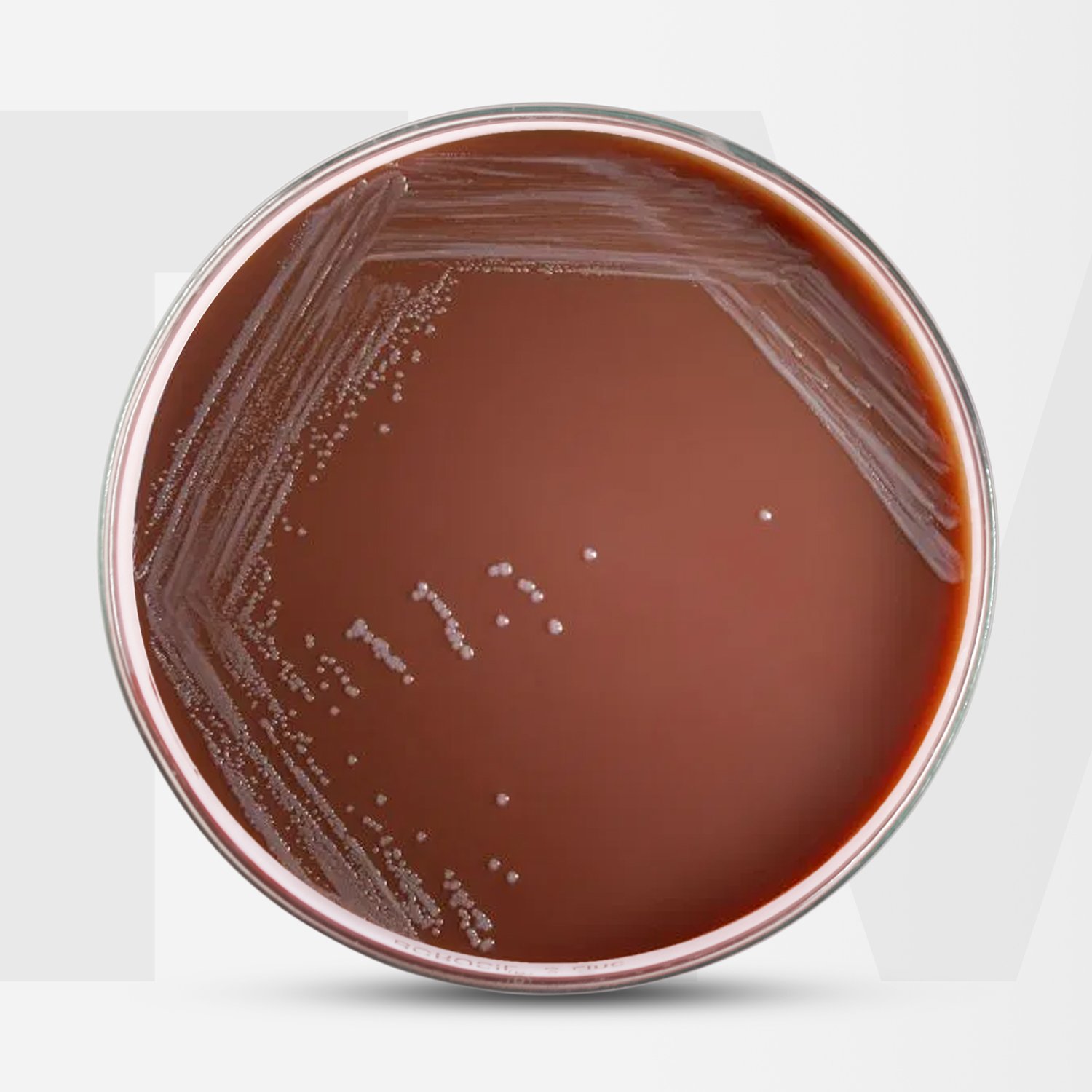
The principle of chocolate agarr is based on the enrichment of the culture medium with nutrients liberated from lysed red blood cells. Heating the blood releases important growth factors, including hemin (Factor X) and nicotinamide adenine dinucleotide (Factor V). These factors favour the growth of several fastidious bacteria which grow poorly or fail to grow on routine media.
Unlike blood agar, the red blood cells in Chocolate Agar are already lysed. Thus, no haemolytic reactions are observed on the surface of the medium.
Instead, it is a medium designed to recover fastidious organisms from clinical specimens enabling microbiologists to isolate them for further identification and confirmatory testing.
Understanding the chocolate agar composition explains why the medium supports organisms that routine media may fail to recover.
The basal medium provides the bacteria with peptides, vitamins, minerals and other nutrients needed for growth. Carefully heated blood releases Factor X and Factor V, which become available throughout the medium after the red blood cells break down.
Some formulations may also include selective supplements when the recovery of specific pathogens is required from mixed microbial populations. These supplements help to limit unwanted bacterial growth and at the same time permit the growth of the target organisms.
The combination makes this agar a reliable medium for the isolation of nutritionally fastidious bacteria from clinical specimens.
| Ingredients | g/L |
| Proteose peptone | 20.000 |
| Disodium phosphate | 5.000 |
| Haemoglobin | 2.000 |
| Dextrose | 0.500 |
| Agar | 15.000 |
| Sodium chloride | 5.000 |
Unlike differential media, chocolate agar is not used to differentiate bacteria by colour changes or biochemical reactions.
Its main use is to recover organisms that need extra nutrients.
Colonies are usually smooth, moist, and well developed after incubation. Their size and appearance may differ depending on the organism. For example, Haemophilus influenzae under appropriate incubation conditions usually produce small, translucent colonies and Neisseria species usually grow as greyish, moist colonies.
Since multiple organisms can produce similar-looking colonies, microbiologists always use other biochemical, serological or molecular methods for ultimate confirmation.
Modern microbiology has advanced rapidly. PCR, MALDI-TOF MS, and genome sequencing have enhanced the speed of microbial identification. However, these technologies do not eliminate the need for culture media. Many laboratory investigations still require a living bacterial isolate. Without the isolate, susceptibility testing, strain preservation and several confirmatory procedures cannot be completed.
This is one reason why chocolate agar is still used in routine laboratory workflows.
Culture media support rather than compete with molecular methods, providing viable organisms for further investigation.
Reliable results depend on good laboratory technique as much as the culture medium itself. If working with dehydrated chocolate agar media, prepare the basal medium as recommended. Use sterile blood when temperature is controlled to maintain necessary growth factors.
Avoid unnecessary exposure of ready-to-use plates prior to inoculation and handle them aseptically.
Always incubate the plates in the appropriate atmosphere and for the specified time. If suspicious colonies are obtained, perform appropriate confirmatory testing before reporting the result.
One of the first choices in microbiology is selecting the proper culture medium.
The target organism may be present in the specimen, but without meeting the nutritional requirements, it is difficult to recover. The employment of an enriched medium enhances the chance of isolating fastidious bacteria from important clinical specimens.
Understanding the use of this agar in different laboratory applications also helps microbiologists to choose the appropriate workflow in routine culture and diagnostic investigations.
Chocolate Agar has been an important enriched medium in the microbiology laboratories for several decades. It has the capacity to supply important growth factors for the recovery of a number of fastidious bacterial pathogens that may not grow on routine media.
Although modern diagnostic technologies have evolved, culture methods still play an important role in laboratory practice. Recovery of viable organisms for identification, antimicrobial susceptibility testing, quality assurance and research is still required. This is why chocolate agar still has an important role in today’s microbiological diagnostics.
A. No. Antibiotic sensitivity testing be performed on the media recommended by the standard guidelines.
A. Certain yeasts and fungi will grow but it is not an optimal medium for fungal isolation.
A. Yes. It is also used as a culturing medium for fastidious bacteria for identification and examination.
A. It is suitable for fastidious bacteria, although it supports the growth of many Gram-positive bacteria.
A. There is no haemolysis visible as the red cells are lysed when preparing the medium. There are no intact red blood cells around the colonies, so the bacteria are not able to cause the regular alpha, beta, or gamma haemolytic patterns that are seen on Blood Agar.
A microbiologist receives a mixed sample and prepares a fresh culture plate. The next question seems simple: which organism will...
Read More
A microbiologist opens two Petri plates after incubation. Both plates contain the same sample. One plate shows clear, well-separated colonies....
Read More
When a microorganism moves from the laboratory to commercial biofertilizer production, one question becomes particularly important: what will you use...
Read More
Every morning the microbiology lab receives fresh agar plates from the incubator. Each plate carries dozens of tiny bacterial colonies....
Read More
A water quality laboratory receives samples taken from different points of a distribution network. The testing team shall determine whether...
Read More
A laboratory receives an urgent request after a routine water quality inspection. Drinking water samples come into a municipal water...
Read More
How can I help you today?
