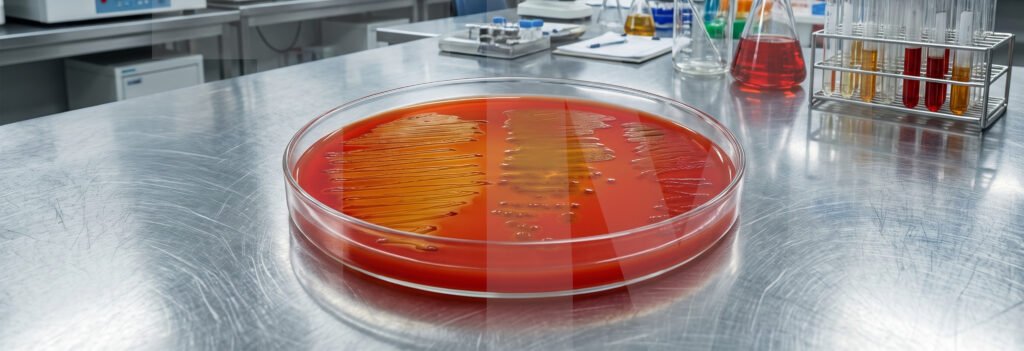
At some point all microbiologists have experienced this situation at least once.
A clinical specimen arrives at the laboratory. It can be a throat swab, wound swab, sputum sample or any other sample where bacterial infection is suspected. When the sample is received the next question is not simply whether bacteria are present. The real question is which bacteria are growing and how can they be identified accurately?
This is where the choice of culture medium becomes important.
Some microorganisms have simple nutritional requirements and grow on routine media without difficulty. They too need certain nutrients to develop visible colonies. While at the same time, the lab needs hints that make it possible to distinguish one organism from another at an early stage.
This is one of the reasons why Blood Agar remains a staple in the microbiology lab. It allows the culturing of a wide range of clinically relevant bacteria and also gives information on their haemolytic activity, enabling microbiologists to make an early presumptive identification before they start with confirmatory testing.
Unlike selective media that inhibit the growth of certain microorganisms, it is an enriched as well as a differential medium. It is suitable for the cultivation of both non-fastidious and fastidious bacteria while allowing detection of haemolysis around bacterial colonies.
The medium combines a nutrient agar base with 5% defibrinated sheep blood. The extra blood provides additional growth factors for fastidious organisms and also serves as an indicator for haemolysis reactions.
During bacterial growth on an agar plate, certain species will produce compounds called haemolysins that interact with red blood cells. These reactions cause changes that are visible in the surroundings of the colonies and give the microbiologist a valuable clue about the organism under consideration. However, a definitive identification cannot be made on the basis of haemolysis alone. To identify the organism, microbiologists perform other biochemical, serological, or molecular tests.
Many microbiologists have seen the familiar patterns of colonies on the plate, but understanding of the composition of blood agar explains why the medium is so effective.
The basal medium contains all the required nutrients, amino acids, vitamins and minerals that are necessary for the growth of bacteria. The addition of sterile defibrinated blood is responsible for increasing nutritional values of the medium and showing haemolytic reactions during incubation.
These combined elements provide a culture medium that facilitates the recovery of many clinically important bacteria and also enables their differentiation by their interaction with red blood cells.
| Ingredients | Gms / Ltr |
| Casein enzymic hydrolysate | 14.000 |
| Agar | 12.500 |
| Sodium chloride | 5.000 |
| Peptic digest of animal tissue | 4.500 |
| Yeast extract | 4.500 |
| Sheep Blood | 50.000 ml |
One of the reasons microbiologists routinely use Blood Agar is that colony appearance provides more information than simple bacterial growth.
Certain organisms completely lyse the red blood cells around the colony. This results in a clear, transparent zone around the bacterial growth.
A common example is Streptococcus pyogenes, which is generally associated with complete haemolysis.
Some bacteria break down red blood cells only partially. Instead of a clear area, the medium turns greenish or brownish around the colony.
This type of reaction is commonly seen with Streptococcus pneumoniae and viridans streptococci.
Not all bacteria produce haemolysins. Some bacteria, however, grow well without changing the surrounding medium. This characteristic is termed as gamma haemolysis or non-haemolysis.
These reactions help microbiologists narrow down the possible organisms before they perform confirmatory tests.
Many people associate Blood Agar with clinical bacteriology, but its applications extend well beyond hospital laboratories.
Clinical Laboratories: Blood Agar is the standard media that is used for the culture and examination of bacteria isolated from throat swab, wound swab, sputum, ear swab and many other clinical samples. The haemolytic reactions are often the first clue to the potential pathogen.
Veterinary Microbiology: Animal diagnostic laboratories also employ the medium to isolate bacterial pathogens that cause infections in livestock, poultry, and companion animals.
Pharmaceutical Quality Control: Pharmaceutical microbiology laboratories routinely employ blood agar media in the examination of microbiological samples or in contamination studies when isolation of fastidious organisms is required.
Research and Teaching Laboratories: Blood Agar is widely used by academic institutions and research laboratories to observe the activity of bacterial colonies as well as various haemolysis patterns during practical training.
Modern laboratories have access to technologies such as PCR, MALDI-TOF MS, and genome sequencing. These techniques have significantly reduced the time of microbial identification.
Even so, culture methods are still essential.
Molecular techniques may detect bacterial DNA but they do not necessarily provide a viable isolate for antimicrobial susceptibility testing, epidemiological studies, or further characterization.
This is what keeps Blood Agar useful. This allows microbiologists to recover viable organisms for further laboratory investigations whenever required.
Instead of replacing culture techniques, modern diagnostics work alongside them.
Blood agar has been and still is one of the most popular culture media in the microbiology lab for decades.
Its ability to support the growth of fastidious bacteria while allowing observation of their haemolytic activity makes it useful for the initial assessment of a large number of clinical isolates. Understanding the composition of blood agar and colony morphology interpretation enable microbiologists to presumptively identify an organism prior to performing confirmatory tests.
While the methodologies used in the laboratory are constantly developing, culture media are still necessary for microbiological diagnosis. Isolation of a viable organism is still required for identification, antimicrobial susceptibility testing, and many quality control applications. Blood Agar is therefore a routine and reliable medium in the microbiology laboratory.
A. Yes. Certain yeasts and fungi do grow on this agar but it is not suitable for the isolation of fungi.
A. Freshly prepared plates are used to ensure the red blood cells are intact and hemolytic reactions are clearly visible. Older plates may result in reduced performance and make interpretation of colonies more difficult.
A. No
A. The reliability and reproducibility of haemolytic reactions are higher with sheep blood and the hemolytic pattern of bacteria can be easily differentiated.
A. Some anaerobic bacteria will grow on this agar in the presence of proper anaerobic conditions.
A. Sheep Blood Agar is an enriched and differential medium that supports the growth of many bacteria while demonstrating their haemolytic activity. The haemolysis patterns around colonies help in the presumptive differentiation of bacterial species.
A microbiologist studies a bacterial culture that looks no different from many others. Yet, its metabolic capabilities may be an...
Read More
A small tube sits on a microbiologist’s bench, looking almost ordinary. Its orange medium waits for one biological event to...
Read More
A microbiologist often looks beyond what appears on a culture plate. A tiny change in colour can reveal an important...
Read More
A colony appearing on an agar plate may look like a simple result. Yet, that small colony reflects everything the...
Read More
A microbiologist receives a mixed sample and prepares a fresh culture plate. The next question seems simple: which organism will...
Read More
A microbiologist opens two Petri plates after incubation. Both plates contain the same sample. One plate shows clear, well-separated colonies....
Read More
How can I help you today?
