
In their daily life, a microbiologist works with a variety of samples. And the one who works with Stool Samples is familiar with the common challenge of stool samples.
How to find the hidden pathogen from a pool of harmless intestinal bacteria?
In the clinical laboratory settings, when a faecal sample comes with the suspicion of salmonellosis or shigellosis, the main aim is now to identify the enteric pathogens Salmonella and Shigella. These target organisms are probably contributing a small fraction of the total microbial population present in the sample. Hence, it is difficult to find them without a Selective Culture Media.
Hope you know about Selective Culture Media if not, then click to know: https://www.tmmedia.in/selective-media-the-gatekeeper-of-microbiology-labs/
So now back to our topic, so this is the situation when hektoen enteric agar (HE Agar) comes into the frame or we can say on the LAF (Laminar Air Flow).
HE Agar is a medium that performs double duty. It is both a selective and a differential agar but it is not a general-purpose agar. This medium contains bile salts and its speciality is that it inhibits many Gram-positive organisms and reduces the interference arising from them, as our target microorganisms are gram-negative in nature. Other than bile salt, this medium also contains lactose, sucrose, and salicin all of these ingredients help distinguish organisms based on their carbohydrate fermentation patterns.
And the most impressive thing is HE Agar can also detect whether an organism is producing hydrogen sulphide or not. This characteristic helps in rapid identification of Salmonella because its colonies often develop distinctive black centers due to hydrogen sulphide production. Hence, microbiologists can presume the presence of salmonella before biochemical tests.
But Biochemical confirmatory tests are always mandatory because some species of Proteus can also produce hydrogen sulphide and similar black centers colonies. Also, atypical strains may not always exhibit textbook morphology.
So the conclusion is never skip Biochemical Confirmatory Tests.
| Ingredients | g/L |
| Agar | 15.000 |
| Proteose Peptone | 12.000 |
| Lactose | 12.000 |
| Sucrose | 12.000 |
| Bile Salts Mixture | 9.000 |
| Sodium Chloride | 5.000 |
| Sodium Thiosulphate | 5.000 |
| Yeast Extract | 3.000 |
| Salicin | 2.000 |
| Ferric Ammonium Citrate | 1.500 |
| Acid Fuchsin | 0.100 |
| Bromothymol Blue | 0.065 |
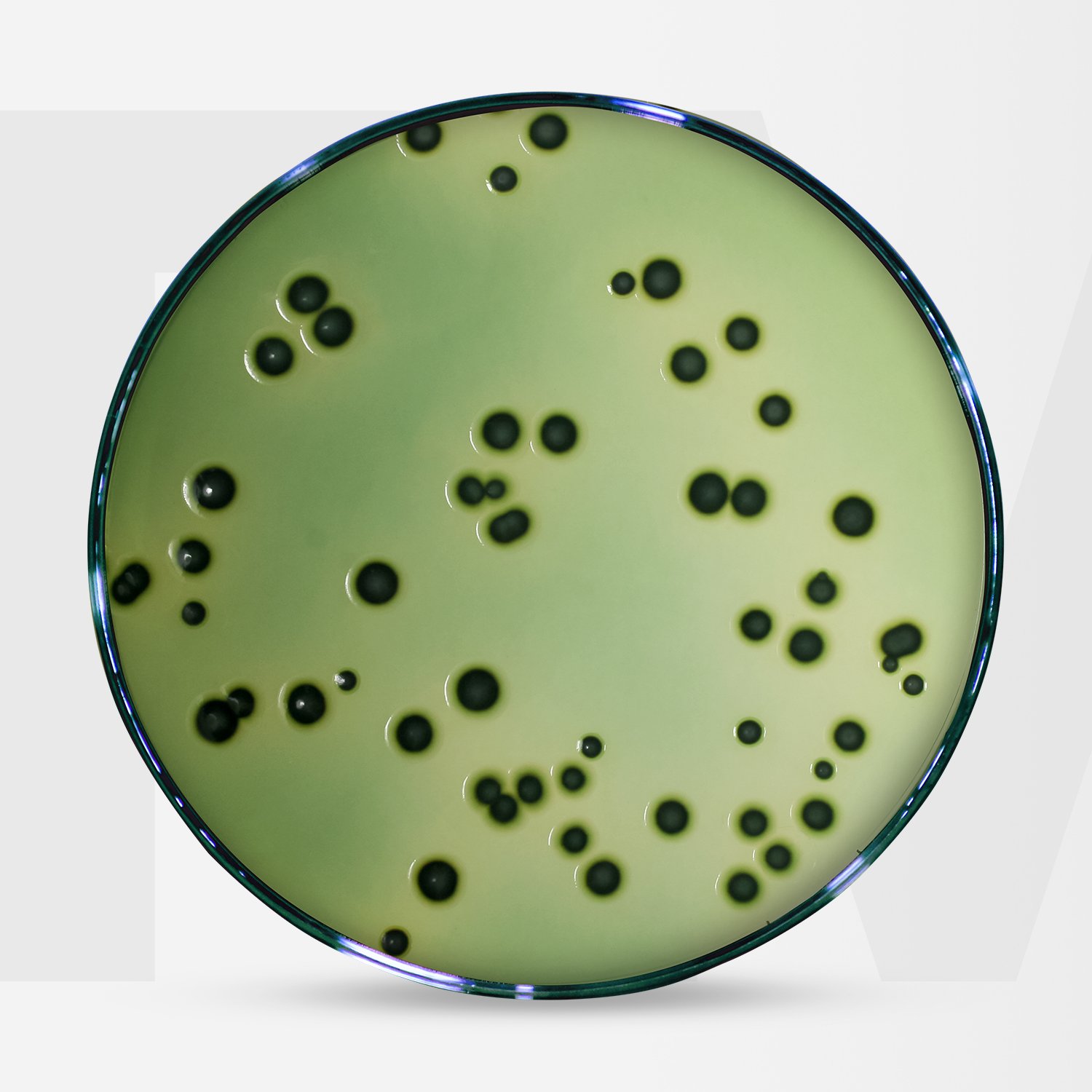
The HE Agar has the ability to translate metabolism reactions into visible clues. Organisms such as E. coli ferment the carbohydrates present in the medium, which results in acid production and orange or salmon-pink-coloured colonies. These bright colonies generally indicate normal enteric flora rather than pathogens.
On the other hand, Shigella species cannot ferment these carbohydrates and appear as green-to-blue-green colonies.
And as previously mentioned, Salmonella species often produce the most recognizable appearance due to hydrogen sulphide production. They appear as blue-green colonies with characteristic black centers.
Suppressing competing flora while simultaneously differentiating pathogens based on their biochemical behaviour, this ability of HE Agar has made it a staple in clinical, food, environmental, and pharmaceutical microbiology laboratories worldwide.
The HE Agar is not only associated with Stool Samples, Salmonellosis or Shigellosis. Its applications extend much further.
Foodborne outbreaks are one of the major public health concerns globally. Food laboratories routinely use HE Agar to investigate poultry, meat products, dairy products, spices, processed foods, and ready-to-eat meals.
Pharmaceutical manufacturing is one of the industries where sterility and asepsis are most important. Any contamination by enteric pathogens can have serious consequences. Pharmaceutical industries frequently use HE Agar during microbiological quality control programmes to screen raw materials and finished products for Salmonella contamination.
Enteric bacterial contamination in water is a serious concern. Water quality laboratories use HE Agar during monitoring of drinking water, wastewater, and other environmental samples.
With the modernization of the world, microbiology labs are also stepping up and we are in the Molecular Era.
Modern diagnostic laboratories rely on PCR, MALDI-TOF MS, and next-generation sequencing technologies that may indicate the presence of Salmonella DNA, but they cannot provide a viable isolate for further analysis. And regulatory agencies, food safety laboratories, and pharmaceutical quality control facilities still require viable isolates for confirmation, antimicrobial susceptibility testing, epidemiological investigations, and strain characterization.
Culture Media (HE Agar) bridges this gap. Because microbiologists can recover the actual organism through colonies. For this reason, culture media continue to play a crucial role alongside molecular diagnostics rather than being replaced by them.
1. Accurately prepared the media.
2. Avoid overheating during preparation.
3. Adhere to the recommended incubation periods for reading plates.
4. Follow up with biochemical and serological tests for confirmation.
1. Open plates aseptically.
2. Adhere to the recommended incubation periods for reading plates.
3. Follow up with biochemical and serological tests for confirmation.
HE Agar is more than a selective agar; it is a practical example of how microbiological principles can be translated into a powerful diagnostic tool. By combining selective inhibition, carbohydrate fermentation analysis, and hydrogen sulphide detection, it enables microbiologists to rapidly identify potential enteric pathogens from a pool of unwanted microorganisms.
With the modernization of labs, traditional culture methods are still the gold standard for identifying, studying and isolating the microorganisms.
A. Yes, some species of Proteus can also produce hydrogen sulphide and similar black centers colonies.
A. Both of them are bacterial infections of the digestive system. Salmonellosis is caused by Salmonella bacteria and shows symptoms such as watery, self-limiting diarrhoea. It is spread through contaminated food. On the other hand, Shigellosis is caused by Shigella bacteria, which cause severe bloody dysentery and it spreads from person to person through the faecal-oral route.
A. It is both a selective and a differential agar.
A. Hektoen Enteric Agar is used to isolate and identify enteric pathogens, Salmonella & Shigella.
A. HE Agar contains lactose, sucrose, and salicin; all of these ingredients help distinguish organisms based on their carbohydrate fermentation patterns.
Two bacterial colonies can appear nearly indistinguishable on an agar plate. Yet their metabolic activities can expose significant differences. A...
Read More
A microbiologist studies a bacterial culture that looks no different from many others. Yet, its metabolic capabilities may be an...
Read More
A small tube sits on a microbiologist’s bench, looking almost ordinary. Its orange medium waits for one biological event to...
Read More
A microbiologist often looks beyond what appears on a culture plate. A tiny change in colour can reveal an important...
Read More
A colony appearing on an agar plate may look like a simple result. Yet, that small colony reflects everything the...
Read More
A microbiologist receives a mixed sample and prepares a fresh culture plate. The next question seems simple: which organism will...
Read More
How can I help you today?
