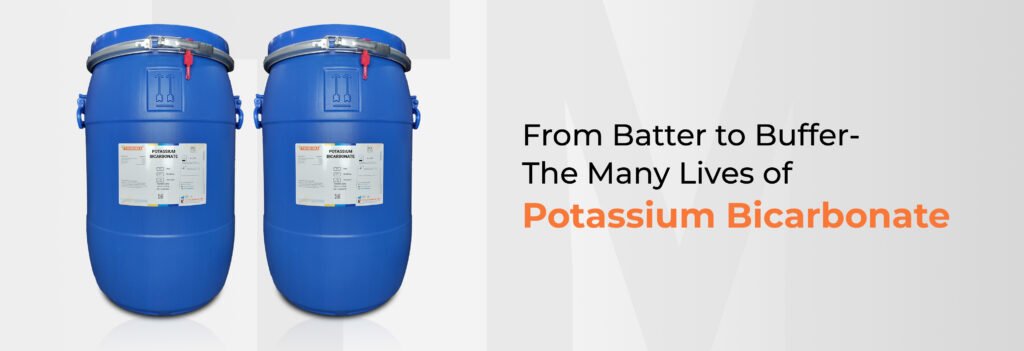
I can almost hear you thinking, “Wait… I didn’t sign up for a baking tutorial.” But humor me—just answer the question. If it’s a no, here’s a pro tip for when you eventually give it a shot: there’s one chemical that can help your cake rise and extinguish a fire in case you forget it in the oven while reading our blogs. Sounds wild, right? Come on, take a guess. Clue – it’s literally in the title of this blog. Absolutely! You nailed it: Potassium Bicarbonate.
So, if your cake rises like it is determined to touch the moon, there’s a good possibility that KHCO3 is involved. And while you rush to get the fire extinguisher, look for the label that reads, “dry chemical”, yes, it’s there too.
Let’s get scientific—with a dash of flour and a pinch of Potassium Bicarbonate.
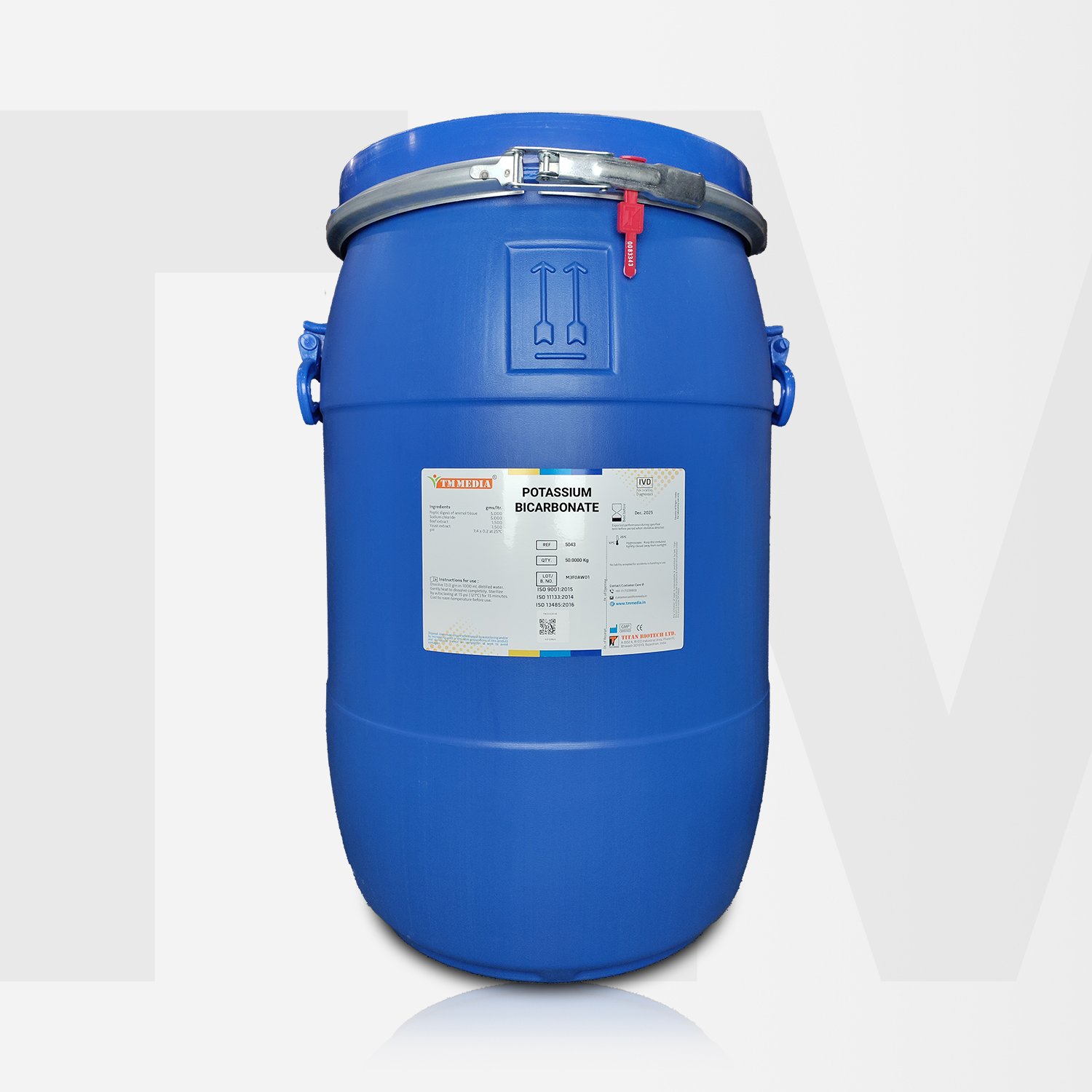
Skeptically enough, Potassium Bicarbonate looks a lot like something you would add to your food, but it is far more versatile than a regular pantry item. It is a compound made up of one potassium cation (K⁺) and one bicarbonate anion (HCO₃⁻) and is denoted by the chemical formula KHCO3. White in color, odorless, a crystalline compound that is highly soluble in water and insoluble in ethanol, making it suitable for aqueous systems that require quick dissolution.
Commonly referred to by its IUPAC name, Potassium Hydrogen Carbonate, it is a monopotassium salt derived from carbonic acid (H₂CO₃) with a molecular weight of 100.11 g/mol.
Much similar to Sodium Bicarbonate (NaHCO₃), Potassium Bicarbonate’s alkaline nature makes it an excellent neutralizing agent, antacid, and, now you know, a good leavening agent, but it has a healthier reputation. Why is that? Because it brings all the rise without the sodium overload.
By keeping in check extreme fluctuations in acidity or alkalinity & maintaining uniformity in formulations, it ensures long-term stability and consistent pH levels in ready-to-eat dishes and fizzy drinks.
Owing to its buffering properties, Potassium Bicarbonate always stands out as an alkaline compound every time and is greatly valued in the food and pharmaceutical industries.
As the chemical formula (KHCO₃) suggests, Potassium Bicarbonate is a simple ionic compound, and can be described as a monopotassium salt of carbonic acid.
The preparation of Potassium Bicarbonate is usually done by a reaction that includes Potassium Carbonate (K2CO3), Carbon Dioxide (CO2), and Water (H2O).
Potassium Bicarbonate, on heating to 120°C, begins to decompose, producing potassium carbonate (K₂CO₃), water (H₂O), and carbon dioxide (CO₂) as byproducts.
Potassium Bicarbonate might not have that sugary sweet aroma or colourful confetti crystals, but it is here to work, not flirt with your senses.
Here’s what makes it stand out in the ingredient lineup:
(Think salt, your food needs just a pinch!)
(No weird chemical smells from your food, but please label the containers to identify)
(Perfect for mixes and drinks- No lumps. No awkward surprises.)
(Nope, it’s not that kind of party)
(Mild, balanced, and always in control)
When it comes to the chemicals you can put in your food, you want them to be clean, stable, and predictable. TM Media’s Potassium Bicarbonate (Product Code: 5043) delivers:
| Parameter | Specification |
| Potassium Bicarbonate | KHCO₃ |
| Formula weight | 100.11g/mol |
| Loss on Drying (Over silica gel, 4 hours) | NMT 0.25% |
| Normal Carbonate | Passes test |
| Lead Content | NMT 2 mg/kg |
| Assay (On Dry Basis) | 99.0% – 101.0% |
1. Alkaline and Buffering agent:
Potassium Bicarbonate is a widely used mild alkali and buffering agent in industries that help regulate the pH levels in compositions of various consumable and non-consumable goods and prevent any unintended changes in flavour, texture, and stability, ensuring your favourite snack stays fresh, even if you didn’t smell a secret chemical guardian behind the scenes.
2. Low-Sodium Leavening Agent
We hear you need to mind your sodium intake, and you have a thing for confectioneries. KHCO₃ functions as a low-sodium alternative to baking soda and reacts with acidic ingredients to release carbon dioxide. Bonus points for fulfilling your body’s potassium demands, improved energy levels, and the fluffiest pastries.
3. Agricultural Fungicide & Potassium Source
KHCO₃ works as an invaluable fungicide in agriculture, especially against powdery mildews. It is also known to work against other fungal infections in fruits, vegetables, and ornamentals by disrupting the cell membranes of spores through dehydration. It works by creating an alkaline environment that fungi find inhospitable, while simultaneously delivering essential potassium to the plants.
4. Fire Extinguisher Ingredient
Remember reading dry chemicals? Potassium bicarbonate is often used in dry chemical fire extinguishers that are especially used for Class B (flammable liquids) and Class C (electrical fires). It smothers the flames by releasing carbon dioxide, and voila!
Potassium Bicarbonate is an unsung hero with many other uses, such as softening carbonation in soda water, reducing the acid content in wine for better flavours, neutralizing acidity in soil for better crop yield, and some personal care formulations.
1. Food-Grade Certified Excellence
TM Media’s Potassium Bicarbonate (Product Code: 5043) is tested meticulously to meet safety and quality benchmarks.
2. Consistently High Assay (99.0–101.0%)
Consistent chemical performance in every application is ensured in each batch by carefully monitoring to maintain a high assay purity.
3. Low Contaminant Levels
It is compliant with international food and pharmaceutical standards and ensures safety and stability with chemical properties like lead content as low as NMT 2 mg/kg and minimal moisture (loss on drying ≤ 0.25%).
4. Freely Soluble in Water
Its excellent water solubility means quicker dispersion in food systems and industrial solutions.
5. Reliable Packaging & Supply Chain
Ideal for bulk users—It is packed in 50 kg industrial-size bags and supplied to all industries.
You know what this means- a top-tier product with no weird mystery additives that is safe enough for all industrial uses and you!

Two bacterial colonies can appear nearly indistinguishable on an agar plate. Yet their metabolic activities can expose significant differences. A...
Read More
A microbiologist studies a bacterial culture that looks no different from many others. Yet, its metabolic capabilities may be an...
Read More
A small tube sits on a microbiologist’s bench, looking almost ordinary. Its orange medium waits for one biological event to...
Read More
A microbiologist often looks beyond what appears on a culture plate. A tiny change in colour can reveal an important...
Read More
A colony appearing on an agar plate may look like a simple result. Yet, that small colony reflects everything the...
Read More
A microbiologist receives a mixed sample and prepares a fresh culture plate. The next question seems simple: which organism will...
Read More
How can I help you today?
