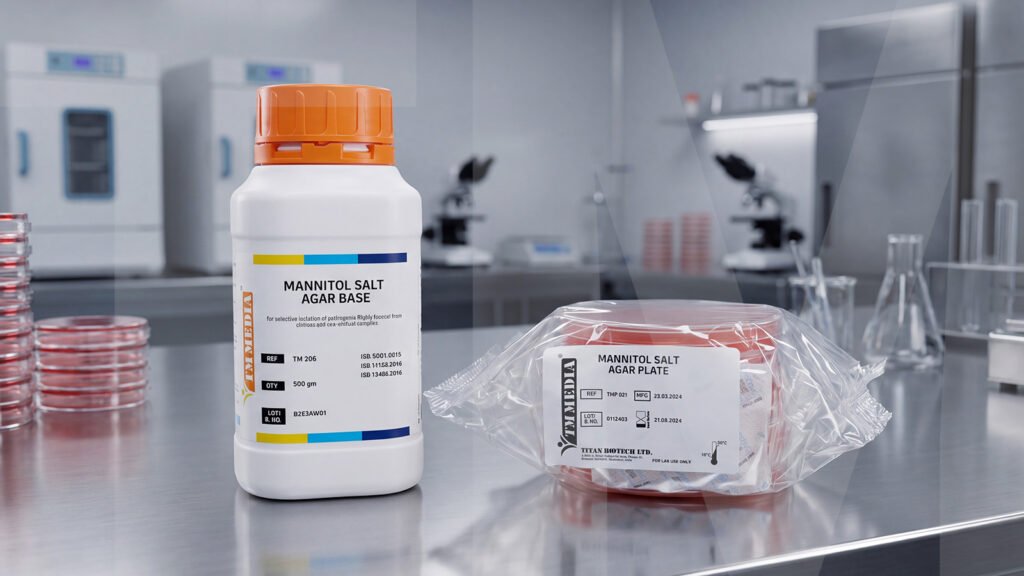
A microbiologist receives a mixed sample and prepares a fresh culture plate. The next question seems simple: which organism will grow? Mixed samples may contain many different microorganisms, making early identification difficult. In the first step, selective media can be helpful in creating conditions which favour certain bacterial groups.
Mannitol Salt Agar offers this advantage for Staphylococcal screening. The high salt concentration is favourable to salt-tolerant Staphylococci while inhibiting many competing bacteria. The medium also uses mannitol fermentation to create a visible differentiation reaction.
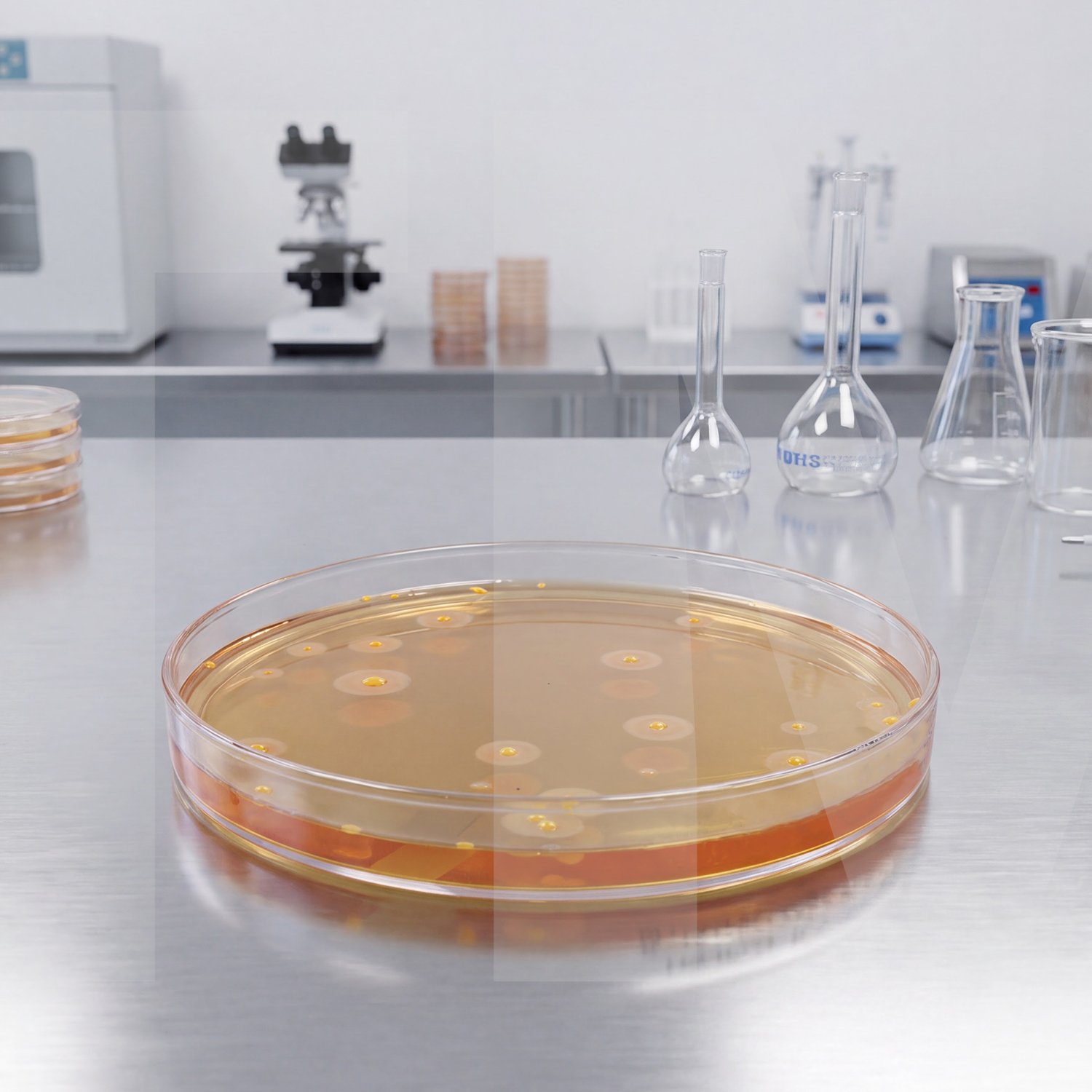
Mannitol Salt Agar is a selective and differential culture medium. Microbiologists mainly use it to isolate Staphylococci from clinical and non-clinical samples. The medium contains a high sodium chloride concentration that limits many competing organisms.
Mannitol provides the differential feature. Some Staphylococci ferment mannitol and produce acidic products. Phenol red detects this change by turning the surrounding medium yellow. Laboratories commonly use this medium as an initial screening tool for suspected pathogenic Staphylococci.
The principle depends on selection and differentiation.
First, sodium chloride inhibits many bacteria which cannot tolerate high salt levels. This gives a growth advantage to salt-tolerant Staphylococci.
Second, D-mannitol as a fermentable carbohydrate is present in the medium. Mannitol-fermenting organisms produce acid during metabolism. Phenol red detects the resulting pH change.
Staphylococcus aureus commonly ferments mannitol. It usually produces yellow colonies with yellow zones around them. Other Staphylococci may not ferment mannitol. They can produce pink to red colonies with red-purple zones.
Microbiologists should treat these reactions as presumptive findings. A suspected S. aureus isolate still requires confirmation with a coagulase test.
The formulation supports selective growth and visual differentiation. Each ingredient performs a specific role within the medium.
| Ingredients | Gms / Ltr |
| Proteose peptone | 10.000 |
| Beef extract | 1.000 |
| Sodium chloride | 75.000 |
| D-Mannitol | 10.000 |
| Phenol red | 0.025 |
| Agar | 15.000 |
The formulation combines selective and differential functions in one medium. It consists of elements for growth, salt tolerance, fermentation and pH indication.
The colour change helps microbiologists interpret the reaction after incubation. It should be assessed along with colony appearance and growth characteristics.
A yellow zone surrounding growth indicates fermentation of mannitol. This reaction is generally observed in S. aureus but it is not sufficient to confirm the species.
If the colonies do not ferment mannitol, the medium may be pink or red. Different strains can also show weaker or delayed reactions.
For this reason, microbiologists should avoid relying on colour alone. Suspected S. aureus isolates require suitable confirmatory tests before identification.
This medium supports selective isolation of suspected Staphylococci from various samples. Laboratories can use it for clinical and non-clinical specimens.
Food and dairy laboratories can apply it during microbial investigations. Cosmetic laboratories can also use it while screening relevant samples.
Researchers can supplement the medium with Egg Yolk Emulsion when they need to examine lipase activity. This activity can appear as yellow opaque zones around colonies.
This approach gives laboratories a clear visual starting point. It also helps separate likely Staphylococcal colonies from unwanted microbial growth during preliminary examination during routine laboratory workflows efficiently.
Several factors may influence the performance of a culture medium in the laboratory testing. It is important to store prepared plates properly, as too much moisture loss can affect their condition.
Quality of ingredients can also influence medium performance. Accurate weighing and proper preparation keep the intended formulation intact.
Contamination during preparation or handling can interfere with the test and produce misleading observations. Aseptic handling therefore remains important throughout the workflow.
Quality control provides another important check before routine use. Laboratories may check the expected performance of media under defined conditions by using suitable control strains.
Following the manufacturer’s instructions for preparation, storage, and handling will help ensure batch-to-batch consistency and facilitate reliable laboratory work.
The consistency of culture media is crucial for reliable routine microbiological testing. Mannitol Salt Agar (TM 206) from TM Media is prepared for the selective isolation and differentiation of Staphylococci.
This medium provides a practical means for the preliminary isolation and differentiation of laboratories screening Staphylococci.
Mannitol Salt Agar remains a useful medium for early screening of Staphylococci. This enables microbiologists to narrow down potential isolates before proceeding to more specific identification tests.
Its value is not limited to growing bacteria on a plate only. It also gives useful visual information that can inform what to do in the next round of testing and investigation.
The medium can be part of routine microbiology workflows when used with relevant controls, validated methods and confirmatory techniques. This makes it an easy option for labs working with different types of samples to use as a primary screen.
A. Mannitol Salt Agar is mainly used as a screening medium. Additional biochemical or identification tests are required for final identification.
A. No. Mannitol fermentation patterns may differ between strains and species. Therefore, this culture medium should not be considered as the determining factor for identifying a species.
A. The isolate can be tested by appropriate confirmatory tests as per laboratory’s identification workflow. Biochemical, enzymatic or instrumental methods of identification may be used.
A. Its high sodium chloride concentration.
A. Yes. Different culture media may be used to provide complementary information in microbial investigations. The choice is made depending on the sample and the purpose of the test.

A microbiologist studies a bacterial culture that looks no different from many others. Yet, its metabolic capabilities may be an...
Read More
A small tube sits on a microbiologist’s bench, looking almost ordinary. Its orange medium waits for one biological event to...
Read More
A microbiologist often looks beyond what appears on a culture plate. A tiny change in colour can reveal an important...
Read More
A colony appearing on an agar plate may look like a simple result. Yet, that small colony reflects everything the...
Read More
A microbiologist opens two Petri plates after incubation. Both plates contain the same sample. One plate shows clear, well-separated colonies....
Read More
How can I help you today?
