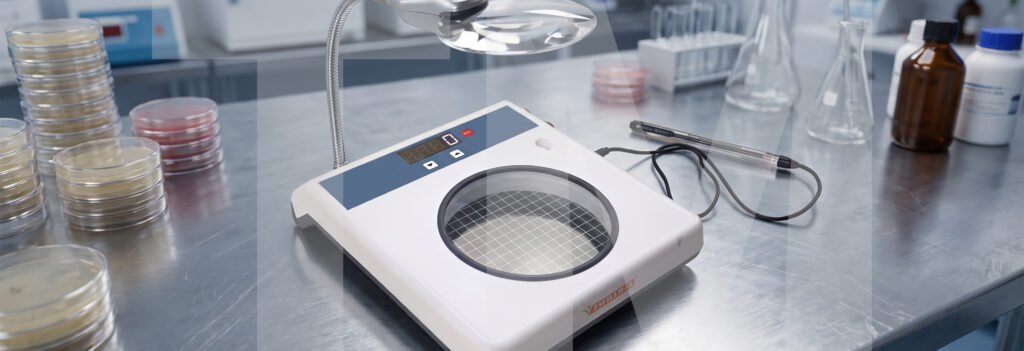
Every morning the microbiology lab receives fresh agar plates from the incubator. Each plate carries dozens of tiny bacterial colonies. The technician must count every colony without errors.
It is easy to make a mistake counting manually with a marker pen. Tired eyes can easily miss faint or overlapping colonies. Laboratories need a faster and more reliable method for this task. This is where a Colony Counter proves useful.
A Colony Counter (TME 010) is a device used to count bacterial colonies on agar plates. It combines illumination, magnification and digital display in one device. It is used by technicians to mark and count colonies with a probe pen. The device reduces human error during routine colony counting. It also speeds up the entire counting process significantly. Most laboratories use it daily for microbiological testing and reporting.
A microbial colony can provide useful information about the tested sample. Laboratories use colony counts to estimate the number of viable microorganisms present.
Food, water, pharmaceutical, and research laboratories use microbial enumeration for different testing purposes. An incorrect count can affect the interpretation of the final result.
Overlapping colonies, faint growth, and poor visibility can make manual counting difficult. Careful counting, therefore, remains an important part of reliable microbiological testing.
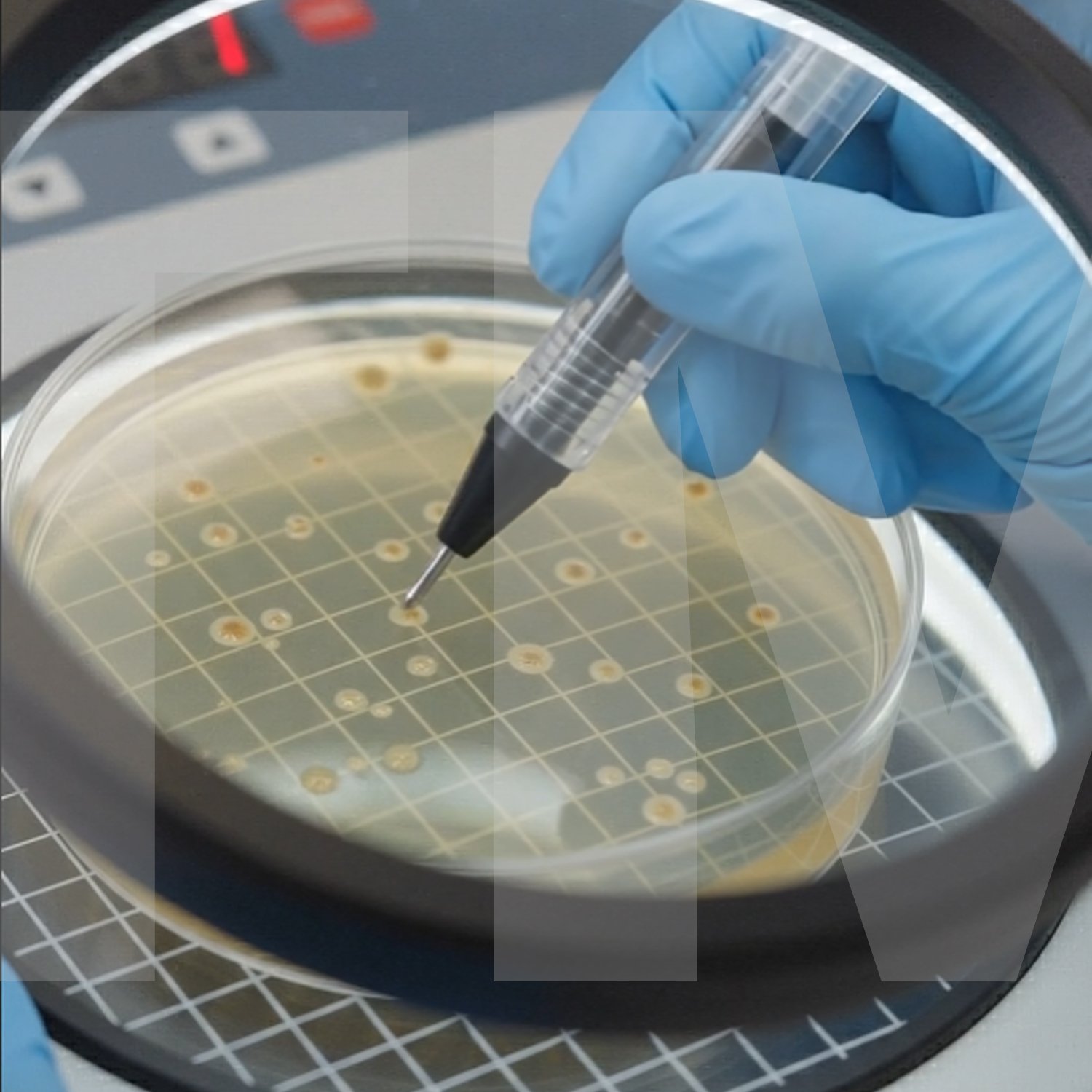
The process begins with a culture plate containing visible colonies. The operator puts the plate onto the platform for counting and adjusts the illumination.
The operator then observes colonies through the viewing area. In a manual system, the operator touches each colony with a sensitive probe pen.
Each touch registers one count on the digital display. Some instruments also provide add and subtract functions. These controls help correct a count when an accidental entry occurs.
Good illumination is useful to distinguish colonies from the surrounding medium. Magnification may allow the smaller colonies to be seen.
Counting can be manual or automated. The automated systems use imaging and software to recognise colonies, while the manual systems need to be observed.
Manual or automatic counting may be chosen by testing labs based on the testing needs. Each method has its own advantages for routine counting of microorganisms.
Manual systems require the laboratory operator to visually observe the sample. They are simple to operate and permit the user to view individual colonies directly.
Automated systems use imaging and software to detect colonies on the culture plate. The system takes the image of the plate and analyses it to find the countable colonies.
Automated counting can reduce repetitive manual work in high-volume testing. It can also provide more consistency across repeated counting tasks.
However, automated systems still require appropriate verification of unusual or unclear results. The method should be selected by the laboratory on the basis of workload, type of sample and resources available.
A manual Colony Counter is suited for routine plate counts where direct operator control is still important. Automation can offer a higher efficiency for labs processing higher plate volumes.
Good visibility and simple operation are what make a counting instrument genuinely useful, and both are built into the Colony Counter (TME 010) from TM Media . These features allow the lab staff to perform routine counting.
The current count is displayed clearly on the digital display. A four-digit display can accommodate counts often encountered when inspecting plates.
Adjustable LED lighting allows the operator to control brightness for different plates. This feature helps to make colonies visible under various viewing conditions.
For a better view, you can use a magnifying glass with 3x or 6x magnification. Colony touches are recorded by a sensitive probe pen with a minimum effort.
Add and subtract functions for quick correction while counting. The base is sturdy and anti-slip to keep the counting platform secure.
The compact design is also great for labs with limited bench space. Such features may assist in convenient counting during routine laboratory work.
A Colony Counter can make counting easier, but there are a number of factors that can affect the final count. Sample preparation, dilution, inoculation and incubation all are important.
When plates are overcrowded, it may be difficult to pick out individual colonies. Uneven distribution can also lead to colonies overlapping.
A uniform handling and a proper plate selection can minimize the errors in the counting. Laboratories should use validated methods to ensure reliable and repeatable results.
Laboratories should consider workload, plate types, and required accuracy before selecting a counting system.
A manual digital system can suit routine counting with direct operator control. An automated system may suit laboratories with higher plate volumes.
The laboratory should also consider available bench space and operating requirements. A compact instrument can provide practical advantages when workspace remains limited.
In microbiology, the Colony Counter supports the practical step between plate incubation and result recording. It helps the operators to clearly visualise the colonies and systematically record their numbers.
In many laboratory tests, visible colonies are important indicators of viable microorganisms. Accurate counting allows laboratories to turn plate growth into useful quantitative information.
The instrument helps in the process by providing illumination, magnification and counting facility. The features are designed to help operators record counts more consistently.
The right instrument can support routine work in food, water, pharmaceutical, clinical, research and educational labs. Reliable results depend on proper sample handling and validated testing procedures.
A. The acceptable range of colony counts is determined by the validated microbiological method. Laboratories shall use method-specific criteria, not one range for all tests.
A. Yes. A colony counter can be used for visible fungal colonies when the culture plate and counting method are suitable for the test.
A. No. A colony counter is intended to count visible colonies growing on solid culture media.
A. Good illumination will make the colonies more visible on the culture plate and facilitate the detection of faint or small colonies in the counting.
A. Yes. They can be used in microbial enumeration, growth and other areas where colony counting is applicable.
Two bacterial colonies can appear nearly indistinguishable on an agar plate. Yet their metabolic activities can expose significant differences. A...
Read More
A microbiologist studies a bacterial culture that looks no different from many others. Yet, its metabolic capabilities may be an...
Read More
A small tube sits on a microbiologist’s bench, looking almost ordinary. Its orange medium waits for one biological event to...
Read More
A microbiologist often looks beyond what appears on a culture plate. A tiny change in colour can reveal an important...
Read More
A colony appearing on an agar plate may look like a simple result. Yet, that small colony reflects everything the...
Read More
A microbiologist receives a mixed sample and prepares a fresh culture plate. The next question seems simple: which organism will...
Read More
How can I help you today?
