A food manufacturer sends two batches of packaged juice to the laboratory. Both batches look the same. They have the same colour, smell, and packaging. There is no evidence that one batch has more microorganisms than the other.
The laboratory can’t rely on appearance alone.
A microbiologist prepares serial dilutions and inoculates culture plates. After incubation one plate shows only a few colonies but the other has many more. Those visible colonies now show something that the naked eye could never see. They represent how many live microorganisms can be found in the sample.
This information enables laboratories to assess the quality of the products along with production hygiene and the presence of microbial contaminants.
That is why the Spread Plate Method still remains the reliable method for microbial count. It enables microbiologists to retrieve the isolated colonies and at the same time get an estimate of the viable microbial load in the sample.
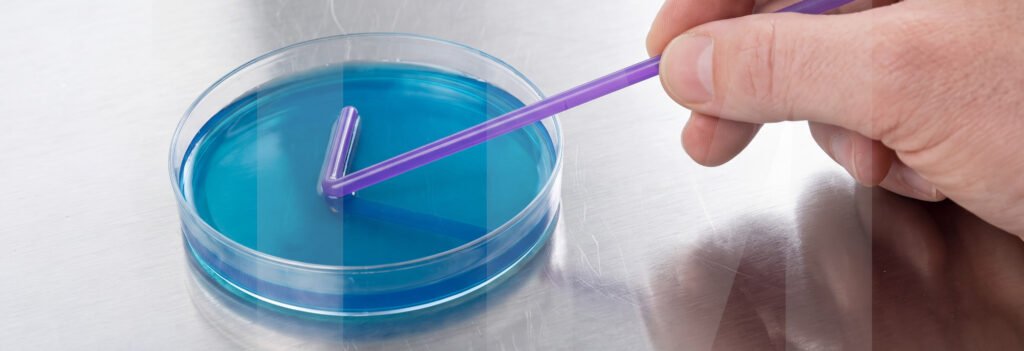
The spread plate method is a microbiological technique used for counting the number of living bacteria in a sample. A measured quantity of the diluted sample is placed on the surface of a solid agar medium. The sample is then evenly spread over the plate using a sterile spreader. Each living cell grows to form a visible colony. These colonies are counted by the lab to give an estimate of the microbial load in the initial sample. The isolated colonies may also be picked for further identification if needed.
Every visible colony originates from a living microorganism. A single microbial cell multiplies to form a discrete colony which can be enumerated. The spread plate method is based on the principle that discrete colonies are formed from viable microorganisms, which allows for enumeration of the microorganisms.
Proper serial dilution is the first step to accurate counts. If the sample is too concentrated, colonies merge and are hard to count. However, excessive dilution may lead to a very low number of colonies and hence to a reduced reliability of the results. Microbiologists therefore prepare a series of dilutions and pick the plate that has well separated colonies.
Following the correct spread plate method procedure is equally important. Use a sterile spreader to spread the inoculum evenly over the surface of the agar. Careful pipetting, appropriate aseptic technique, and appropriate incubation conditions are all important in producing reproducible and reliable colony counts. Well-separated colonies can also be picked for further identification when necessary.
Different microbiological samples require different analytical approaches. Microbiologists choose the spread plate method when they want well-isolated surface colonies for observation and additional testing. Since the sample remains on the agar surface, colony morphology is clearly visible, making the technique useful for routine microbial enumeration and isolation.
Like any laboratory process, minor errors can affect the outcome. Use of a sample volume more than that recommended might hinder the uniform distribution in the agar. A wet agar surface can result in irregular spreading of colonies and uneven spreading may result in clusters that are difficult to count. Poor aseptic practices can lead to the introduction of unwanted contamination, which can affect the accuracy of microbial enumeration.
If laboratories pay close attention to these details, they can obtain reliable and repeatable results without unnecessary variation.
Many microbiology laboratories perform the spread-plate technique to obtain quantitative results and isolated colonies.
It is used in food testing laboratories to estimate microbial populations in beverages, dairy products, processed foods, raw materials and finished products. These results support quality control and verify the effectiveness of manufacturing practices.
The method is used in water testing laboratories for analysis of drinking water, waste water and environmental samples. Routine enumeration of microbes aids in the detection of water quality changes and public health monitoring.
Pharmaceutical laboratories routinely conduct viable counts of raw materials, finished products and environmental monitoring samples as part of quality assurance programmes.
Research and educational laboratories also rely on this technique for teaching microbial enumeration and studying bacterial populations. They also use it to obtain pure colonies for further microbiological investigations.
The most common media used for the spread plate method is Plate Count Agar.
Accurate microbial counts start with reliable culture media.
Plate Count Agar from TM Media is used for the determination of the viable plate count of food, water, wastewater and clinical specimens. Its balanced formulation allows for uniform colony growth and a clear surface for easy counting.
Tryptone, yeast extract, dextrose and agar are added to the medium to support the growth of a wide range of micro-organisms. It is also compliant with ISO 4833-1 & 2:2013 and APHA requirements for microbial enumeration.
Plate Count Agar gives reliable, consistent results in day-to-day lab work, whether you are doing quality control, food testing, water analysis or lab research.
Counting microorganisms is as important as identifying them in microbial analysis. Accurate microbial counts enable laboratories to assess product quality, monitor hygiene and ensure consistent quality standards across different applications.
The spread plate method is still one of the most practical methods for enumeration of viable microorganisms. This allows for reliable colony enumeration and recovery of isolated colonies for further analysis. With proper dilution, careful laboratory technique and a dependable cultivation medium such as Plate Count Agar, the method provides significant and reproducible results.
Despite the advancement of laboratory technologies, the microbial count is still significant in different industries. This is why the spread plate method is still an important part of the modern microbiological laboratory.
It helps to evaluate product quality, to monitor contamination and to confirm microbiological safety.
The dryness of the plate enables the inoculum to spread over a wide area and prevents the merging of colonies.
Serial dilution.
This is usually the result of the sample not being diluted sufficiently before plating.
It is mainly used for aerobic or facultative anaerobic bacteria growing on the agar surface.
A microbiologist finishes inoculating a culture plate and places it inside the incubator. The next day, the plate is covered...
Read More
Every microbiologist has seen this happen. A clinical specimen from a patient with suspected bacterial meningitis is received. The sample...
Read More
At some point all microbiologists have experienced this situation at least once. A clinical specimen arrives at the laboratory. It...
Read More
Most of us have come across algae at some point floating on the surface of a pond, growing along riverbanks,...
Read More
In their daily life, a microbiologist works with a variety of samples. And the one who works with Stool Samples...
Read More
How can I help you today?
