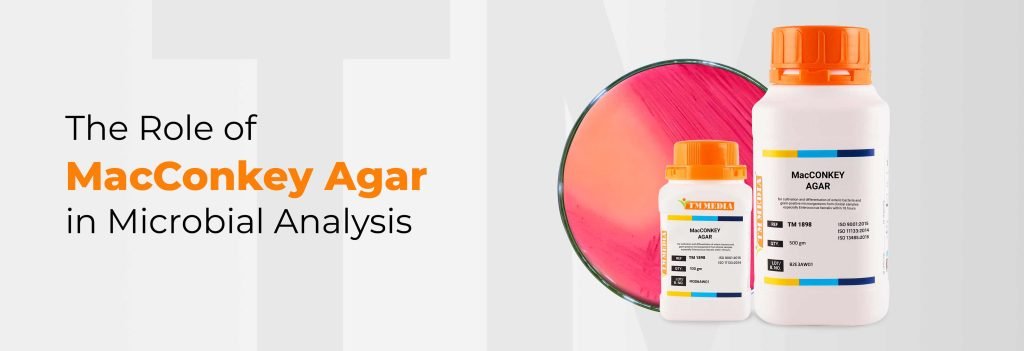
MacConkey Agar is a vital tool in the intricate domain of microbiology, thanks to its composition and versatile applications. This agar medium, developed by Alfred T. MacConkey, has firmly established itself as an indispensable resource for distinguishing subtle microbial differences with exceptional accuracy. Its ability to differentially classify gram-negative bacteria based on their lactose fermentation abilities makes it an excellent tool for researchers and clinicians alike. Moreover, the pink and red colonies produced on the agar medium make it easy to visually differentiate between lactose fermenters and non-fermenters. Its significance and contribution to the field of microbiology cannot be overstated, and it continues to be a gold standard tool for microbiologists worldwide.
| Ingredients | Gms / Litre |
| Peptic digest of animal tissue | 20.000 |
| Agar | 20.000 |
| Lactose | 10.000 |
| Sodium taurocholate | 5.000 |
| Neutral red | 0.070 |
MacConkey Agar provides a distinct environment that caters to the growth and differentiation of both gram-positive and gram-negative bacteria. The medium’s selective properties are attributed to the presence of bile salts and crystal violet. These components are responsible for restricting the growth of gram-positive bacteria, making it easier to detect the presence of coliform bacteria that can ferment lactose.
MacConkey Agar’s distinguishing ability is achieved through the principle of acidic byproduct formation, where lactose-fermenting bacteria produce acidic byproducts that lower the pH of the agar. The addition of neutral red, a pH indicator, allows for easy identification of lactose-fermenting colonies through a pink color change under acidic conditions. In contrast, non-lactose fermenters do not cause a pH change, resulting in colorless or transparent colonies that can be easily distinguished from lactose-fermenting colonies. This makes it a remarkably effective tool for research and experimentation in microbiology.

1. Dissolve 55.07 grams in 1000 ml of distilled water.
2. Heat the solution and swirl it around.
3. Sterilize the solution at 121°C for 15 minutes.
4. Pour the solution into sterile Petri plates at 45-50°C for inoculation
The results of the analysis provide a quick overview of the test. The bacteria are identified based on their lactose fermentation properties:
The Ready-to-Use MacConkey Agar Plates eliminate the need for preparation and pouring, save time, reduce contamination risk, and ensure consistent results. Simplify your laboratory procedures with our MacConkey Agar Plates.
A microbiologist studies a bacterial culture that looks no different from many others. Yet, its metabolic capabilities may be an...
Read More
A small tube sits on a microbiologist’s bench, looking almost ordinary. Its orange medium waits for one biological event to...
Read More
A microbiologist often looks beyond what appears on a culture plate. A tiny change in colour can reveal an important...
Read More
A colony appearing on an agar plate may look like a simple result. Yet, that small colony reflects everything the...
Read More
A microbiologist receives a mixed sample and prepares a fresh culture plate. The next question seems simple: which organism will...
Read More
A microbiologist opens two Petri plates after incubation. Both plates contain the same sample. One plate shows clear, well-separated colonies....
Read More
How can I help you today?
